By Kwabena Lindqvist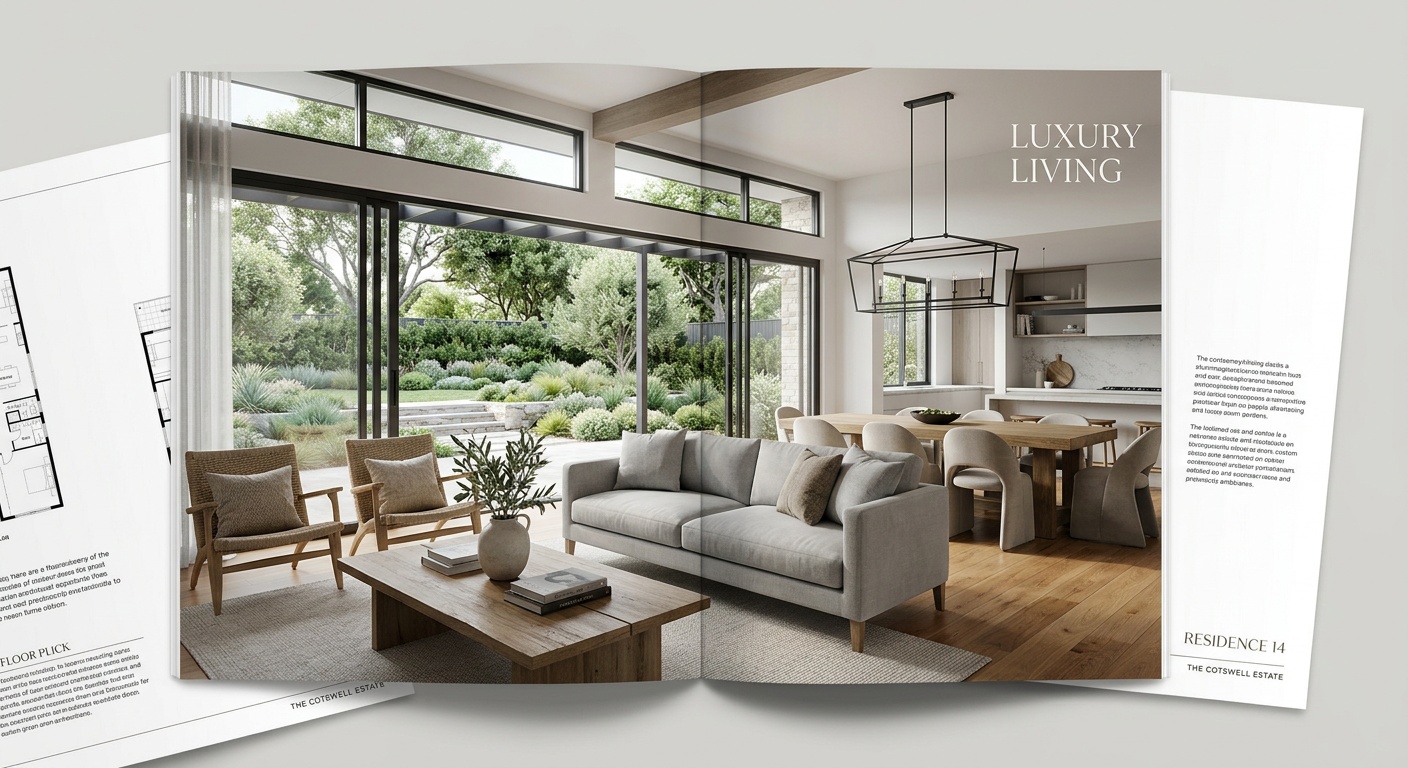
Designing Luxury Brochures That Sell Off-Plan Developments Abroad
Reading time: 9 minutes
Picture this: a couple in Manchester is scrolling through their phone at 11 p.m., half-watching TV, when a brochure PDF lands in their inbox for a beachfront residence in Algarve that hasn’t even broken ground yet. Within ten minutes, they’ve reserved a viewing call. That’s not luck—that’s design doing the heavy lifting for a sale that hasn’t been built yet.
Off-plan property abroad is a peculiar sales challenge. You’re asking someone to commit six or seven figures to a building they can only see in renderings. In 2026, with international buyers pouring an estimated $94 billion into pre-construction residential projects across Dubai, Southern Europe, and Southeast Asia, the brochure isn’t a nice-to-have—it’s the closing tool.
Table of Contents
- Why Off-Plan Brochures Are a Different Beast
- The Anatomy of a Brochure That Converts
- Common Design Mistakes That Kill Trust
- Case Studies From the Field
- Cost vs. Return: Is Luxury Design Worth It?
- Your Roadmap Forward
- FAQs
Why Off-Plan Brochures Are a Different Beast
Selling a finished apartment is about showing what exists. Selling off-plan is about manufacturing belief. Buyers are being asked to trust a floor plan, a timeline, and a developer’s reputation—often from another continent, in a currency they don’t use daily, under a legal system they don’t fully understand.
Well, here’s the straight talk: a brochure that merely looks pretty won’t get you there. It needs to do three jobs simultaneously—build emotional desire, establish financial credibility, and reduce the perceived risk of buying something invisible.
Quick scenario: imagine two brochures for identical villas in Marbella. One shows glossy renders and a price list. The other shows the renders, plus a construction timeline with contractor names, a payment schedule visualized as a simple chart, and a page dedicated to legal protections for foreign buyers. Which one gets forwarded to a lawyer for review? Exactly.
The Psychology of the Distance Buyer
International buyers—especially those purchasing sight-unseen—experience heightened anxiety compared to domestic buyers. Research from property marketing consultancy Currie & Brown in early 2026 found that 68% of overseas off-plan buyers cite “fear of the unknown” as their top hesitation, ahead of price. Your brochure’s job is to systematically dismantle that fear, page by page, without ever sounding defensive.
The Anatomy of a Brochure That Converts
A luxury off-plan brochure isn’t a single document—it’s a sequence of persuasion moments. Here’s how the strongest ones in 2026 are structured:
- The Hook Spread (pages 1-3): Lifestyle imagery, not architecture. Buyers purchase a Tuesday morning coffee on a terrace, not concrete.
- The Vision Section: Master plan, architect’s statement, and sustainability credentials—critical since 74% of luxury buyers under 45 now ask about energy ratings before price.
- The Proof Layer: Developer track record, previous completed projects with photos, and financial backing disclosures.
- The Numbers Page: Payment plans, ROI projections, rental yield comparisons—presented visually, never buried in paragraphs.
- The Legal Safety Net: Escrow arrangements, title deed process, and buyer protection schemes specific to that country.
- The Call to Reserve: A clear, low-friction next step—QR code to a virtual tour, WhatsApp concierge line, or booking calendar.
Materials and Format Choices That Signal Quality
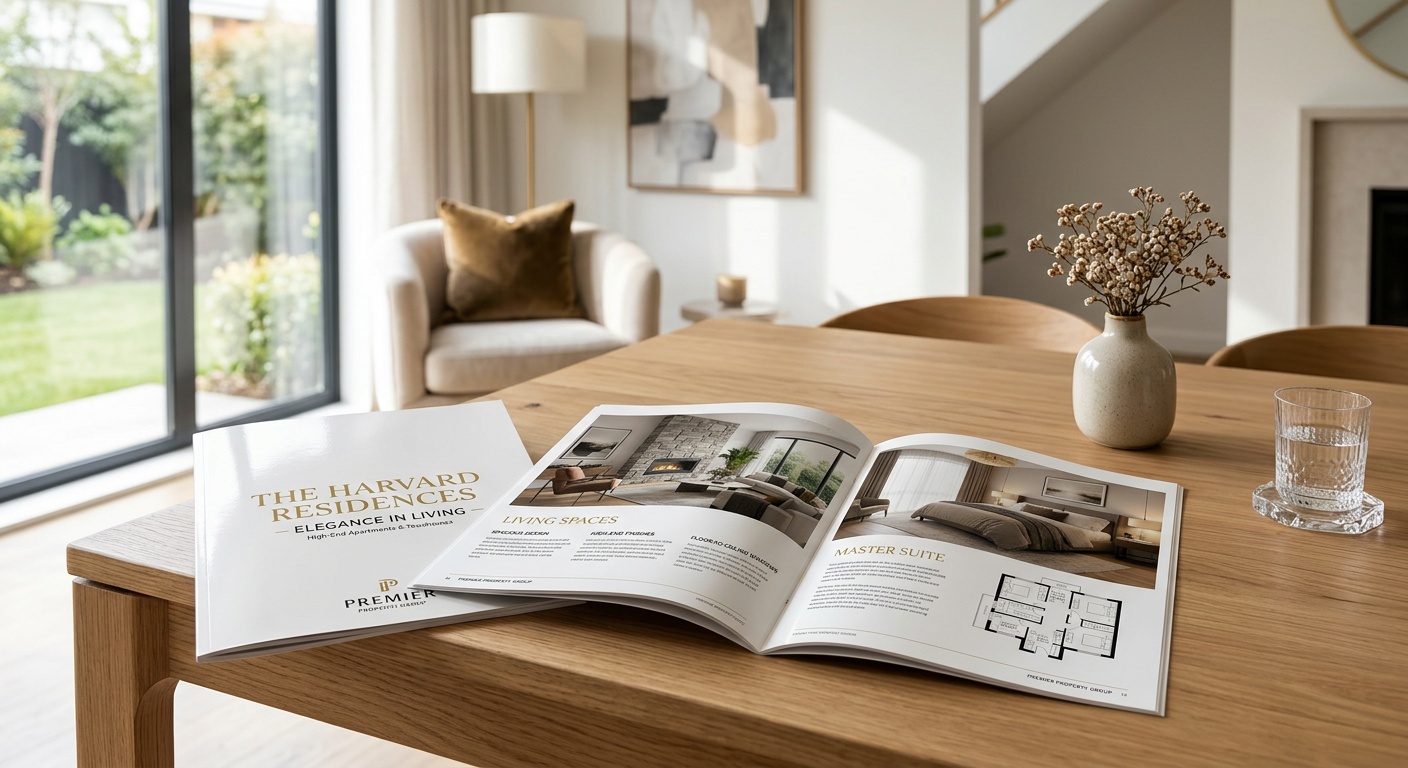
Digital PDFs dominate initial outreach, but the physical brochure hasn’t died—it’s become a status object. Developers targeting buyers above £750,000 are increasingly commissioning printed brochures on 300gsm uncoated stock with foil-blocked covers, mailed in branded boxes rather than envelopes. It’s a small cost—typically £18-£45 per unit—that signals the development itself will be finished to the same standard.
Digitally, interactive PDFs with embedded video walkthroughs are now standard for anything above the mid-market. Static PDFs increasingly feel dated to buyers who are used to swiping through immersive content on Instagram and TikTok before they ever speak to an agent.
Common Design Mistakes That Kill Trust
Even beautifully designed brochures fail when they trip over a handful of recurring errors:
- Renders that oversell reality. Buyers now cross-reference CGIs against Google Street View and site progress photos. A gap between promise and plausibility erodes trust instantly.
- Hidden or vague pricing. Omitting service charges, transfer taxes, or currency assumptions creates resentment during due diligence and often kills deals at the lawyer stage.
- No localization. A brochure written for a UK buyer and lightly translated for a German or Gulf buyer, without adjusting currency, measurement units, or cultural imagery, reads as lazy—and expensive developments shouldn’t feel lazy anywhere.
Pro Tip: Treat every brochure as a legal-adjacent document, not just a marketing one. If your sales copy promises something the contract doesn’t guarantee, you’re building a dispute, not a sale.
Case Studies From the Field
Case Study 1: A Dubai Marina Tower That Sold Out in 11 Days
A 2025-launched, 42-storey residential tower in Dubai Marina restructured its brochure around a “day in the life” narrative rather than a floor-by-floor spec sheet. Each amenity—infinity pool, private cinema, co-working lounge—was paired with a short lifestyle vignette instead of a bullet list of dimensions. The developer reported the entire inventory of 210 units, ranging from $410,000 to $2.1 million, reserved within 11 days of the brochure’s release to their agent network, with 61% of buyers based outside the UAE.
Case Study 2: A Portuguese Golden Visa Project’s Trust Rebuild
Following regulatory changes to Portugal’s Golden Visa scheme in 2025, one Algarve developer noticed reservation rates dropping despite strong renders. The fix wasn’t visual—it was structural. They added a four-page “Legal Confidence” insert explaining escrow protections, the notary process, and a step-by-step visa eligibility flowchart. Within one sales quarter, conversion from brochure download to deposit rose from 4.2% to 9.6%, according to the agency handling distribution.
Case Study 3: When Luxury Design Backfired
Not every glossy brochure wins. A Greek island villa project in 2024 leaned so heavily into abstract, art-directed photography that buyers couldn’t tell how many bedrooms units actually had, or where the plot boundaries sat. Sales stalled for four months until the agency rebuilt the document with clearer floor plans layered beneath the same lifestyle imagery—proving that beauty without clarity is just an expensive brochure nobody can act on.
Cost vs. Return: Is Luxury Design Worth It?
Here’s the comparative data developers are working with in 2026, based on aggregated figures from three European and Gulf-focused property marketing agencies:
| Brochure Tier | Avg. Production Cost/Unit | Avg. Lead-to-Reservation Rate | Buyer Trust Score (1-10) |
|---|---|---|---|
| Basic Digital PDF | £150 – £400 | 1.8% | 5.1 |
| Standard Print + Digital | £1,200 – £3,000 | 3.4% | 6.7 |
| Premium Interactive + Print Box | £4,500 – £9,000 | 6.9% | 8.3 |
| Full Immersive (VR + Concierge Kit) | £12,000+ | 9.2% | 9.0 |
The pattern is consistent across markets: every jump in production quality correlates with a measurable jump in trust and conversion, but the returns flatten past the “Premium” tier for most projects under $1.5 million per unit. Above that price point, the immersive tier still pays for itself through fewer stalled negotiations.
Visualizing the Trust Gap
Practical Roadmap for Your Next Brochure
- Audit your renders against reality. Cross-check every CGI against actual site conditions and construction schedules before printing a single page.
- Localize beyond translation. Adjust currency, measurement units, and even color psychology for target markets—red signals luck in China but can signal caution elsewhere.
- Front-load legal reassurance. Don’t bury escrow and title information in an appendix; buyers decide within the first five pages whether they trust you.
- Pair every amenity with a lifestyle moment. “24-hour concierge” means less than “someone collects your dry cleaning while you’re at the beach.”
- Test conversion, not just aesthetics. Track download-to-enquiry and enquiry-to-reservation rates per brochure version, not just design approval from internal stakeholders.
An industry consultant specializing in Gulf and Mediterranean residential launches put it plainly this year: “The brochures that outperform aren’t the most beautiful ones on a designer’s portfolio—they’re the ones that answer the question a nervous buyer hasn’t asked out loud yet.”
FAQs
How long should an off-plan luxury brochure be?
Most high-converting brochures in 2026 run between 24 and 40 pages. Shorter documents often fail to address legal and financial concerns fully, while anything beyond 40 pages tends to dilute attention and reduce completion rates on digital versions.
Should pricing always be included in the brochure itself?
For markets like Dubai and Portugal, yes—transparent pricing builds trust and filters serious buyers early. In some ultra-luxury Gulf projects, however, developers intentionally omit pricing to drive direct consultation, a strategy that works only when the brand reputation is already extremely strong.
What’s the biggest translation mistake developers make?
Assuming translation equals localization. A literal translation of “cozy” into some languages reads as “small” or “cramped,” which can actively repel buyers. Working with a native-speaking copywriter familiar with property marketing, not just a translation service, avoids this trap consistently.
Your Roadmap Forward
The off-plan brochure of 2026 has evolved from a glossy sales leaflet into a trust-building instrument that has to work harder than almost any other document in international real estate. As buyer sophistication rises and cross-border scrutiny increases, the developments that win won’t necessarily have the flashiest renders—they’ll have the clearest answers.
- Treat legal transparency as a design feature, not a compliance afterthought.
- Invest in localization that respects cultural nuance, not just language conversion.
- Measure your brochure the same way you’d measure a sales funnel—because that’s exactly what it is.
If you’re planning your next launch, ask yourself honestly: does your brochure sell a lifestyle, or does it sell confidence? The developments thriving in this market have learned it needs to do both, at the same time, on every page. What will your next brochure prove to a buyer who’s never set foot on your site?