By Kwabena Lindqvist
Crafting Property Sales Gallery Displays That Impress International Investors
Reading time: 9 minutes
Table of Contents
- Why Sales Galleries Still Matter in 2026
- The Psychology Behind First Impressions
- Core Elements of a Winning Display
- Technology That Bridges Distance
- Common Mistakes and How to Fix Them
- Data Snapshot: What Investors Actually Notice
- FAQs
- Your Next Move
Why Sales Galleries Still Matter in 2026
Ever walked into a property sales gallery and felt instantly underwhelmed—cardboard models, faded brochures, a lonely agent scrolling on their phone? International investors notice that within seconds, and they remember it long after they’ve boarded their flight home. In a market where cross-border real estate transactions reached an estimated $412 billion globally in 2025 according to Knight Frank’s Wealth Report, the physical (and digital) sales gallery has become a make-or-break touchpoint for developers courting overseas capital.
Here’s the straight talk: a sales gallery isn’t decoration. It’s a trust-building machine. For an investor flying in from Singapore, Dubai, or São Paulo, that gallery is often the only tangible proxy they’ll have for a building that won’t exist for another 18 to 36 months. Get it wrong, and you lose not just a sale but a relationship that could have generated referrals for years.
The Shift Toward Experience-Led Selling
Post-pandemic buyer behavior didn’t just recover in 2026—it evolved. Investors now expect galleries to function like flagship retail stores: sensory-rich, data-backed, and frictionless. A 2025 survey by CBRE found that 68% of high-net-worth international buyers said “immersive presentation quality” directly influenced their decision to reserve a unit before completion. That’s not a marginal factor; it’s a primary driver.
The Psychology Behind First Impressions
Quick Scenario: Imagine two nearly identical waterfront condo projects in Bali, each priced similarly and targeting the same buyer persona—a mid-40s investor from Hong Kong looking to diversify into Southeast Asian real estate. Project A’s gallery uses static renders and a single scale model. Project B’s gallery includes a scent-branded entryway (light citrus and teak, evoking the actual location), a 4K drone flythrough, and a concierge who speaks Cantonese. Which one closes faster?
Unsurprisingly, Project B does—and not by a small margin. Behavioral economists call this the “peak-end rule”: people judge experiences based on the most intense moment and the final impression, not the average. Your gallery needs at least one “peak” moment that investors will describe to their spouse or business partner on the flight home.
Building Emotional Anchors, Not Just Visual Ones
Emotional anchoring works because investors are rarely buying square footage alone—they’re buying a lifestyle narrative, a rental yield story, or a legacy asset for their children. Successful galleries weave these narratives into every station: the entry lounge sets tone, the model room sells scale, the lifestyle zone sells emotion, and the closing suite sells numbers.
Core Elements of a Winning Display
Let’s dive deep into what actually belongs in a gallery designed for an international, often first-time-in-country audience.
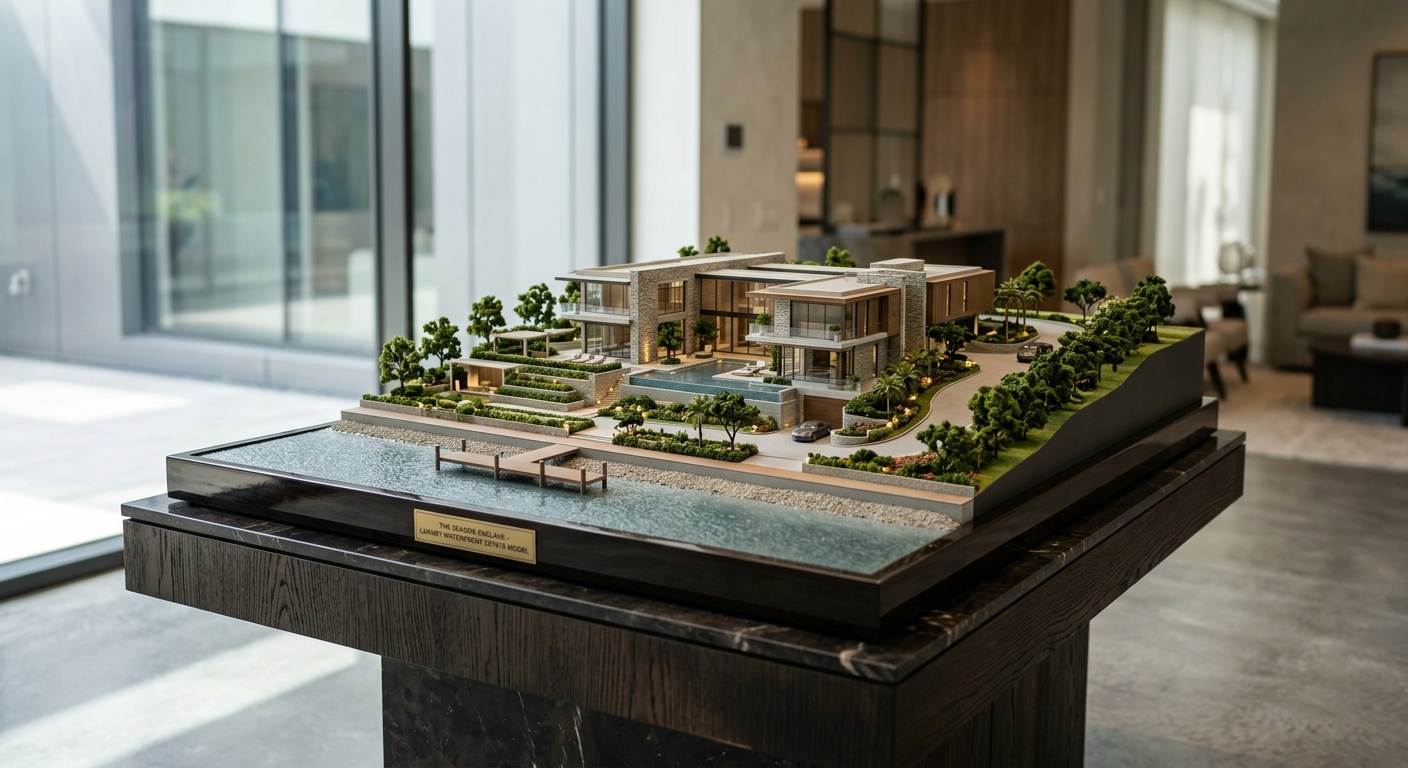
- Scale models with lighting sequences that simulate day-to-night transitions, helping buyers visualize the property across time zones they’ll never personally witness in person.
- Multilingual digital kiosks offering floor plans, payment schedules, and yield projections in at least three languages relevant to your target markets.
- Show units furnished for aspiration, not just function—investors from different cultures respond to different cues (feng shui layout awareness for Chinese buyers, for example, or prayer-room proximity for Gulf investors).
- Financial clarity stations where currency conversion, mortgage-free cash flow models, and rental yield comparisons are displayed transparently.
- A dedicated concierge zone for private, unhurried conversations—international buyers often dislike being rushed through open-plan galleries shared with dozens of local walk-ins.
Pro Tip: Rotate at least one display element seasonally. A gallery that looks identical in March and November signals stagnation, and sophisticated investors read stagnation as risk.
Technology That Bridges Distance
Not every investor can fly in for a walkthrough, and that’s precisely where 2026’s gallery technology earns its budget line. Real estate consultancy JLL reported that developers integrating virtual reality (VR) headsets and live-streamed gallery tours saw a 31% increase in reservation conversion from overseas leads compared to those relying solely on PDF brochures and email follow-ups.
Practical Roadmap for Digital Integration
- VR Walkthroughs: Offer headset-based tours that let investors “walk” from the lobby to a specific unit’s balcony view.
- Live Video Concierge: Schedule real-time video calls with bilingual sales staff who can pan cameras across the physical gallery on demand.
- Digital Twins: Provide a browser-based 3D twin of the development, updated monthly with construction progress footage.
- AI-Assisted Financial Modeling: Let investors input their currency and holding period to instantly see projected returns adjusted for exchange rate volatility.
Case in point: a mixed-use development in Lisbon launched in early 2025 introduced a “Remote Reservation Suite”—a scheduled 45-minute video session replicating the in-person gallery experience station by station. Within four months, 22% of total sales came from buyers who never physically visited the gallery before signing a reservation agreement. That’s the kind of result that reshapes marketing budgets.
Common Mistakes and How to Fix Them
Even well-funded projects stumble. Three recurring issues surface again and again when developers debrief after underwhelming investor turnout.
Mistake 1: Overloading with information. Investors don’t want forty brochures; they want three decisive facts—price trajectory, rental yield range, and legal ownership structure for foreigners. Fix this by training staff to lead with a “three-fact opener” before diving into details.
Mistake 2: Ignoring cultural nuance in scheduling. Gulf investors, for instance, often prefer evening appointments during Ramadan-adjacent periods; Chinese New Year travel patterns shift Q1 visitation for East Asian buyers. Fix this with a culturally-aware booking calendar reviewed quarterly.
Mistake 3: Weak follow-up infrastructure. A stunning gallery visit followed by a generic templated email kills momentum. Fix this with a CRM workflow that sends a personalized video recap referencing the specific unit and conversation points discussed during the visit.
Data Snapshot: What Investors Actually Notice
Below is a simplified visualization based on aggregated 2025-2026 buyer feedback surveys across three regional real estate consultancies, showing the percentage of international investors who cited each factor as “highly influential” in their gallery visit experience.
The takeaway is clear: financial transparency and show-unit quality outrank flashy tech alone. Technology should support, not replace, tangible credibility.
| Gallery Type | Avg. Setup Cost | International Conversion Rate | Ideal Use Case |
|---|---|---|---|
| Basic Static Display | $15,000–$40,000 | 4–7% | Small local projects |
| Hybrid Physical + Digital Kiosk | $60,000–$120,000 | 12–18% | Mid-size regional developments |
| Full Immersive VR Suite | $150,000–$300,000 | 22–31% | Luxury towers targeting overseas buyers |
| Remote-First Concierge Model | $80,000–$150,000 | 18–22% | Projects with distant, time-zone-heavy audiences |
| Boutique Experience Gallery | $100,000–$200,000 | 20–27% | Branded lifestyle developments (resort, wellness) |
FAQs
How much should a developer realistically budget for an internationally-focused sales gallery?
Most competitive mid-to-luxury projects in 2026 are budgeting between $80,000 and $200,000, depending on how much digital infrastructure—VR headsets, live concierge systems, multilingual kiosks—is included. The key isn’t spending the most; it’s aligning spend with your specific buyer persona’s expectations.
Is virtual reality actually necessary, or is it a passing trend?
Based on 2025-2026 conversion data, VR isn’t a gimmick anymore—it’s becoming baseline expectation for buyers who can’t visit in person, which for many international projects represents 30-50% of total leads. That said, VR should complement, not replace, transparent financial displays and quality furnished units, which investors consistently rank as more influential.
How do we handle cultural differences without overcomplicating the gallery design?
Start small: hire or train at least two bilingual staff members covering your top source markets, adjust show-unit staging cues (layout, decor, prayer or feng shui considerations), and build a flexible appointment calendar respecting regional holidays and time zones. You don’t need five separate gallery versions—just thoughtful modular elements that can be swapped based on who’s visiting that week.
Your Roadmap Forward
Crafting a gallery that genuinely impresses international investors isn’t about chasing every new gadget—it’s about strategic sequencing of trust, emotion, and hard numbers. As cross-border capital flows continue reshaping global real estate in 2026 and beyond, the developments that win will be the ones treating their sales gallery as a core product, not an afterthought.
- Audit your current gallery against the three top-ranked investor factors: financial transparency, show-unit quality, and multilingual accessibility.
- Pilot one remote-first tool, such as a scheduled video concierge session, within the next quarter.
- Build a simple cultural calendar flagging peak travel and holiday periods for your top three source markets.
- Train your team on the “three-fact opener” technique to avoid overwhelming first-time visitors.
- Review follow-up personalization—replace generic templates with recap videos referencing each visitor’s specific conversation.
So, here’s the real question: when the next investor walks through your doors—or logs into your virtual tour—will your gallery tell a story worth flying across the world for?